

Bachelor of Science in Information Technology Management
Create Resources Through Priorities and Needs
The College of Engineering and Technology (CET) offers a specialized program in the field of Information Technology Management.
The program has been designed by information technology professionals to assist students in building their career in the IT industry.
The curriculum focuses on problem-solving skills and techniques required to deliver computer-based solutions to real-world scenarios.
Students develop and communicate technological solutions to different industrial issues, manage systems operations, improve, and simplify
the technology transfer into industries and governments. Students learn to implement ethical judgments and critical thinking to measure,
and evaluate the impact of information technology on modern social, political, and economic issues.
- Demonstrate IT and Management concepts, techniques, skills, and tools.
- Identify professional, security, ethical and social issues in IT and Management processes.
- Effectively communicate knowledge and concepts in teams to achieve desirable goals.
- Design computer programs or processes to meet business needs.
- Contribute to professional knowledge and field of practice of information technology.
Program Mission
The Information Technology Management program mission is to equip students with Information Technology skills and Management concepts.
The program aims at developing students’ applied research skills, preparing them for lifelong learning and enabling them to contribute
to the Information Technology field.
Program Goals
- Seek professional development and postgraduate degrees in the fields of Information Technology and Management.
- Work in teams and demonstrate effective communication and collaborative research skills.
- Demonstrate knowledge and skills in the fields of Information Technology and Management.
- Show ethical, professional and social qualities.
- Be an effective member of the community and make positive contributions to the society.
Program Learning Outcomes
PLO 1: Demonstrate a comprehensive understanding of business and management concepts, techniques, skills, and tools.
PLO 2: Analyze and implement solutions to real-world problems using appropriate computing tools.
PLO 3: Develop and implement IT governance strategies and employ ITM to align with an organization’s long-term goals.
PLO 4: Recognize professional responsibilities and exercise informed judgment in IT practice based on legal and ethical principles.
PLO 5: Exhibit self-development capabilities, work autonomously, and engage effectively in team collaborations.
ADMISSION REQUIREMENTS
For further information, please click here
GRADUATION REQUIREMENTS
For undergraduate degree completion, undergraduate students must satisfy the following requirements:
- Earn a minimum CGPA of 2.00 on a scale of 4.00.
- Successfully complete all courses as described in the study plan.
- The Degree Completion requirements must be met within the timeframe of the program.
- Transfer students must successfully earn a minimum of 50% of the course credits for the program at AUE.
ACCREDITATION

Preparatory Courses
Prior to their enrollment in the program, students applying for Bachelor of Science in Information Technology Management must sit for the placement test related to the program, failure to successfully passing the placement test, they are required to enroll in the following courses :
| # | Course Code | Course | Credit Hours | Exemption Condition |
| 1 | CIT 90 | Computer Preparatory | 0 | Passing the Placement Test |
| 2 | MAT 90 | Mathematics Preparatory | 0 | Passing the Placement Test |
| 4 | ENG 99 | Academic Writing (*) | 0 | Passing the Placement Test |
PROGRAM STRUCTURE
Course Category
Total Number of Courses
Total Number of Credit Hours
General Education Courses
11
33
Core Courses - Business
8
24
Core Courses - IT
19
60
Free Elective
3
9
Total
41 Courses
126 Credit Hours
Courses & DESCRIPTIONS
GENERAL EDUCATION COURSES
11 COURSES | 33 CREDIT HOURS
A: University Core Requirements
Students are required to complete 9 credit hours (3 courses) from the following list:
This course offers an introductory exploration of Artificial Intelligence (AI) for students across all disciplines. It focuses on applying AI concepts and tools practically without delving deeply into specialized or theoretical content. Students will learn basic AI concepts through practical exercises, including problem-solving, decision-making, simple machine learning, reinforcement learning, probabilistic learning, and natural language processing. The course will emphasize the impact of AI on society, ethics, and everyday life, preparing students to understand and engage with AI in various contexts. By the end of the course, students will have a comprehensive understanding of artificial intelligence, its branches, and practical applications across real-world domains
B: Languages and Communication Studies
Students are required to complete 9 credit hours (3 courses) from the list below:
This course provides students with advanced writing skills in English so that they can successfully pursue their studies in various academic specializations. It helps students to develop, improve, and upgrade their writing and structure skills, and it also acquaints students with technical writing, research papers, and essays since brief research methods are applied in student projects and assignments.
Students must take one of the following Arabic Language courses:
C: The Natural sciences or Mathematics
The student selects 6 credit hours (2 courses) from the list below:
D: The Humanities or Arts
The student selects 3 credit hours (1 courses) from the list below:
E: Islamic Studies
The student selects 3 credit hours (1 course) from the list below
F: UAE Studies
The student selects 3 credit hours (1 course) from the list below
CORE COURSES – BUSINESS
8 COURSES | 24 CREDIT HOURS
This principal level course introduces students with the fundamentals of accounting terms, rules, concepts, procedures, and systems. Topics covered include the art of recording, classifying, and analyzing the data into useful information for both the internal and external users. Students are introduced to the double entry accounting concepts, general journals, and the accounting cycle.
This course marks students’ first journey into the discipline of management. The focus of this course is to expose students to the fundamentals of the four functions of management of planning, organizing, leading and controlling. Within each function students are introduced to a multitude of managerial areas of focus including decision-making, organizational structure, power and politics, leadership, teams, motivation, and communication.
This course is designed to introduce students to basic microeconomics concepts relating to individual decision-making. The course exposes students to the meaning, nature, and methods of studying Microeconomics. The concepts of supply, demand, and elasticity are used to analyze the behaviors of consumers and firms in different types of markets. Main topics covered include: consumer behavior, firm production costs, Pure Competition, Monopolistic Competition, Monopoly, and Oligopoly.
This course familiarizes the students with the scope, terminology, topics, and procedures of marketing in a modern company. It introduces the principles of marketing with providing a comprehensive overview of the marketing process from marketing research and analysis up to capturing customer value. Marketing channels, developing marketing strategies, consumer behavior, societal marketing, and new product planning are also discussed.
The course is aimed to provide both theoretical explanations and practical understanding of the utilization of information system in managerial decision making. Further it is aimed to discuss procedure for planning of the information system, as well its proper organization and application in technological advancements. The course is mainly of a managerial outlook, aimed for better utilization of the latest information technology for managerial planning, organizing, implementation and decision making at all levels of managerial activities.
The General Statistics course is designed to develop good understanding of the basic concepts of statistical theorems, and applications. The course covers topics such as data collection methods, organization of data, analysis and interpretation of results. A software package will be used to analyze the statistical data.
This course aims to acquire a sound education in those statistical concepts and its applications in the fields of business and economics. This course requires fundamental understanding of basic statistics like frequency distribution, averages, measures of variability, probability, confidence intervals. The course also recommends a prior understanding of software application and MS Excel. Course covers statistical concepts and methods like hypothesis testing, variance Tests, chi-Square analysis and ANOVA with an emphasis on business application.
Organizational behavior studies the influence of individuals, groups, and work culture on behavior within organizations; its chief goal is to improve an organization’s effectiveness. This course introduces students to the core concepts of organizational behavior including attitudes, emotions, and moods; communication; conflict and negotiation; diversity; group behavior and work teams; individual decision making; leadership and power; motivation; organization culture and structure; organizational change; and personality and values.
CORE COURSES – IT
19 COURSES | 60 CREDIT HOURS
Multimedia Technology course will enhance the understanding of fundamentals of multimedia techniques using computer software. The course shall go into deep details of defining features, uses and practical development considerations for each of the major multimedia content such as text, graphics, sound, and video. Several compression algorithms for digital and analog multimedia content will be covered. A portion of this course concentrates on how communication of multimedia content works by highlighting various networking techniques to efficiently communicate by avoiding errors in communication. The course includes several hands-on exercises on creation and manipulation of multimedia content using various tools like Adobe Photoshop, Audacity and Windows Movie Maker etc. These exercises will strengthen the practical multimedia production skills. Furthermore, students will be equipped with skills and knowledge of enhancing the web pages using HTML and ASP.NET language embedded codes for video, sound, text and images.
This course focuses on topics such as DBA roles, DBMS security, data administration, backup and recovery, clustering and replication, resource management and database tuning. The course aims at equipping the students with the following learning outcomes.
The course provides a hands-on introduction to fundamental technologies that are essential in building and marketing e-commerce solutions. Students will learn the skills to utilize available software to create a fully functional ecommerce website with shopping cart and secure order processing, and methods to market it using online advertisement. The course emphasizes the importance of back-end server applications interfacing with a database and teaches its development. Topics covered include business models for e- Commerce, e-Commerce Infrastructure, e-Commerce Security and payments, e- Commerce marketing and advertising, ethics, law and online media. This course requires that students should have working knowledge of HTML and database management before taking this course.
The goal of this project is to explain the necessary skills of project management with a strong emphasis on issues and problems associated with the successful delivery of IT projects. This course is designed to provide a thorough understanding of the theory and practice of project management through an integrated approach that includes the concepts, tools, methodologies, skills, and techniques managing information technology projects. CIT 404 focuses on information technology projects with the following course objectives: issues associated with information technology projects, successful and failed information technology projects, and teamwork practices in information technology projects. The course covers all related aspects and issues of managing IT projects. These include, project management tools, such as Gantt charts and critical paths, project contexts, processes, and management of integration, cost, scope, time, human resources, quality, communications, and risks of an IT project.
The course is aimed at introducing the students to the interdisciplinary field of Human Computer Interaction which integrates concepts from Computer Science, Design and Cognitive Psychology. Topics include introduction to Human Computer Interaction, Interaction Design principles, User Experience, Usability Testing Evaluating and Designing interfaces. The course will be a mix of theory and practice; where the concepts will be introduced, and interface prototyping and evaluation will be conducted.
Advanced Topics in IT uses a variety of teaching strategies to expose students to real world scenarios which are current industry challenges. The approach ensures CCIT graduates are equipped with contemporary skill sets required in the ever-changing Information Technology industry. The course provides a platform for students, academics, and practitioners to discuss various specializations in the Information Technology industry. Learning of soft and hard skills are reinforced through write ups, oral and presentation of professional reports. The course enables students explore distinct areas of Information Technology which are not covered in the regular course work and focuses on the identification of long-term overall aims and interests and the means of using Information Technology to help businesses achieve their organizational goals. Topical issues including using Information Technology to elevate production by suppling uninterrupted processes which optimize resources and allow organizational leaders to make quick, accurate, and consistent decisions are studied via case studies analyses. By learning through an array of teaching methods and cutting-edge research in Information Technology students are prepared for successful leadership roles in organizations and government. Students on this course also acquire skills and knowledge that ensure any implemented Information System meets industry best practice. Topics covered in this course include Information Technology implementation strategies, Operations and post implementation of Information Technology, Information Technology program and project management, Organizational change and Process Reengineering, global ethics and security management, value chain and data analysis.
This course aims to clarify the processes modifying-on an existing system or proposing a new system that facilitates the achievement of clearly defined business objectives. The course introduces Systems Development Life Cycle (SDLC) methodologies and explains the SDLC phases starting from Planning: by developing a comprehensive system proposal document that includes the business analysis, feasibility analysis and scheduling the tasks of developing the new system, moving to Analysis where requirements are being defined, use case analysis, data flow and entity relationship diagrams are introduced. Then to system design by introducing system acquisition strategies, architecture, user interface, program and database design, to the implementation phase and finally the transition to the new system.
The goal of the capstone graduation project is to evaluate the aptitude of students to independently complete a project in an area of their preference (e.g., software and web development, network administration and security systems, database systems, and digital forensics). The responsibilities required are identifying a research area and developing a project proposal identifying the research aim, objectives, research plan, time schedule, and estimated budgets. Students are required to present their findings through an oral presentation and written thesis.
This course provides students with an understanding of the key principles and concepts of IT governance, as well as how it affects risk management, IT investment management, and alignment of IT with business goals. Students will use the proper frameworks and standards to examine IT governance possibilities and challenges in various business situations. Based on corporate requirements and priorities, they will create effective IT governance frameworks and strategies. They will also use pertinent metrics and performance indicators to assess how well IT governance procedures are working. Students will learn how to use the right tools and strategies to collaborate effectively on IT governance-related challenges.
ELECTIVE COURSES
3 COURSES | 9 CREDIT HOURS
Students are required to complete 9 credit hours (3 courses) from courses offered by any other college or specialization, provided that the prerequisites of the selected courses are met.
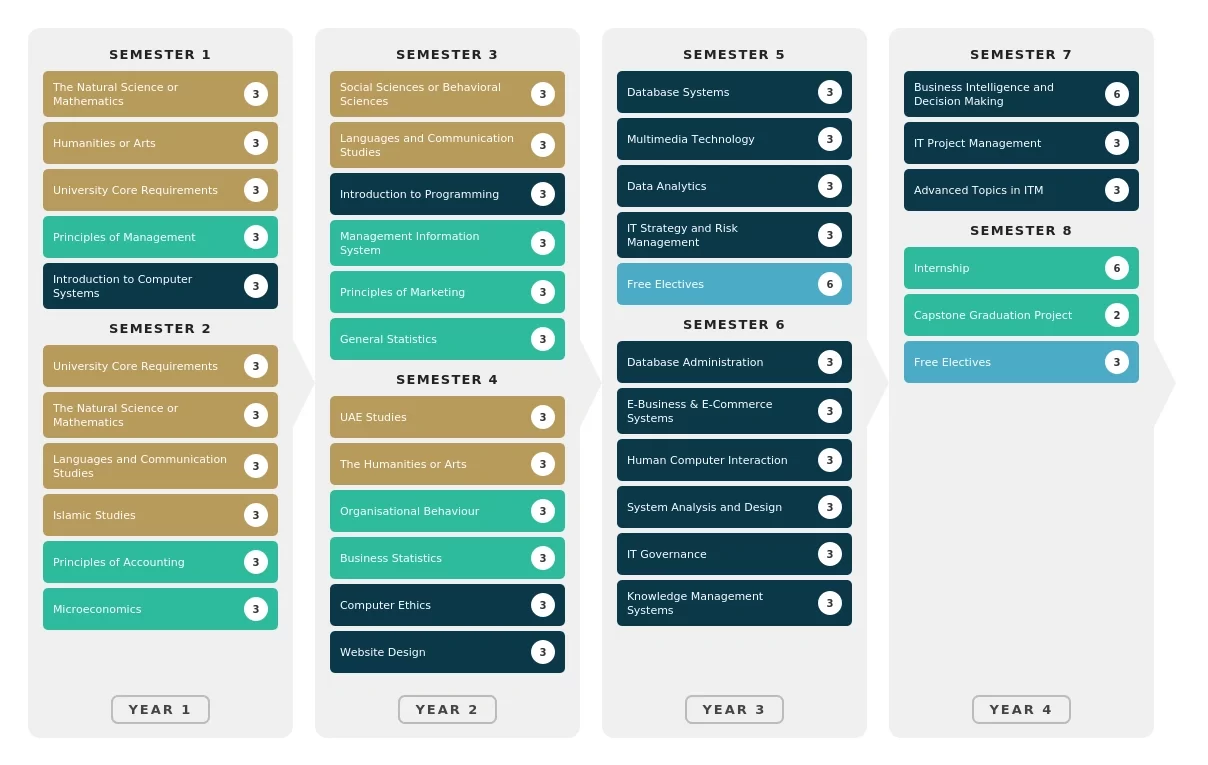
RECOMMENDED STUDY PLAN
Program Director

Dr. Alyaa Amer
Assistant Professor / Department Chair - Computer Science / Acting Department Chair - Information Technology Management