

Bachelor of Law
(Instruction Language is Arabic)
PROGRAM OVERVIEW
A bachelor’s degree in law is an undergraduate academic qualification awarded by college of law after completing a structured program of study, typically requiring 130 credits over three-four years of full-time study. It provides foundational legal education and is the primary qualification for practicing legal profession. It covers core subjects of public and private law and often serves as the required academic step before bar admission. Earning a bachelor’s degree demonstrates mastery of a broad knowledge base, critical thinking, analytical skills, and the ability to complete a rigorous academic program.
PROGRAM OBJECTIVES
- Establish principles and rules that contribute to activating the protection of human rights and basic freedoms, as well as working on raising the status of the individual.
- Prepare highly-competent legal staff capable of coping with contemporary legal developments.
- Provide distinguished legal research that contributes to understanding and resolving issues at a community-level.
- Improve students’ linguistic capacities and expand their understandings of the Arabic language, its concepts and definitions for use in legal cases.
- Develop scientific research in various branches of law in line with the rules of the United Arab Emirates.
- Fill the local and regional market’s need for experts and specialists in various branches of law.
EDUCATION SYSTEM
The College of Law follows the credit hours system, which determines the number of hours of study that must be completed and passed according to the level determined by the university to obtain a Bachelor’s degree.PROGRAM LEARNING OUTCOMES
- Provide students with knowledge about the origins of law and foundational theories pertaining to its various branches and applications.
- Provide students with knowledge about the principles of the legal and judicial system in the United Arab Emirates.
- Provide students with knowledge about scientific research methods in the legal field to solve emergent legal problems.
- Provide students with the skills to interpret and analyze legal rules and judicial rulings in accordance with scientific principles.
- Provide students with the skills of legal drafting and verbal arguments.
- Provide students with the skills to use information technology and communications to analyze legal problems.
- Provide students with the ability to express their personal opinions clearly and take responsibility for the work entrusted to them.
- Provide students with the ability to work independently, while observing the morals and ethics of the profession.
PROGRAM Goals
- Provide students with knowledge and understanding of the basic subjects of general, public and private laws.
- Teach students the methods and techniques of legal research.
- Educate students to learn to step back and consider the legal situation as a whole.
- Allow students to demonstrate a critical awareness of the legal context.
- Enable students to develop transferable skills in legal research, legal problem-solving and legal communication.
ADMISSION REQUIREMENTS
For further information, please click here
GRADUATION REQUIREMENTS
For undergraduate degree completion, undergraduate students must satisfy the following requirements:
- Earn a minimum CGPA of 2.00 on a scale of 4.00.
- Successfully complete all courses as described in the study plan.
- The Degree Completion requirements must be met within the timeframe of the program.
- Transfer students must successfully earn a minimum of 50% of the course credits for the program at AUE.
ACCREDITATION

Preparatory Courses
Prior to their enrollment in the program, students applying for Bachelor of Law must sit for the placement test related to the program, failure to successfully passing the placement test, they are required to enroll in the following courses:
| # | Course Code | Course | Credit Hours | Exemption Condition |
| 1 | CIT 90 | Computer Preparatory | 0 | Passing the Placement Test |
| 2 | ARA 90 | Arabic Preparatory | 0 | Passing the Placement Test |
PROGRAM STRUCTURE
Course Category
Total Number of Courses
Total Number of Credit Hours
General Education Courses
10
30
Core Courses
36
94
Specialization Courses
2
6
Total
48 Courses
130 Credit Hours
PROGRAM MODULES & DESCRIPTIONS
GENERAL EDUCATION COURSES
10 COURSES | 30 CREDIT HOURS
A: University Core Requirements
The student selects 6 credit hours (2 courses) from the list below:
B: Languages and Communication Studies
The student selects 9 credit hours (3 courses) from the list below:
This course provides students with advanced writing skills in English so that they can successfully pursue their studies in various academic specializations. It helps students to develop, improve, and upgrade their writing and structure skills, and it also acquaints students with technical writing, research papers, and essays since brief research methods are applied in student projects and assignments.
The intent of this course is two-fold. First, it introduces students to the basic research terminologies. Second, it familiarizes them with the process of research from choosing a topic to writing the proposal. Students will be immersed in a hands-on experience where they will be introduced to research concepts that will help them understand, interpret, and review a journal article. Contents to be covered include the language of research, types of research, elements of the scientific research proposal, writing an academic research proposal using APA style, research ethics, identifying data collection instruments, and interpreting data.
Students must take one of the following Arabic Language courses:
C: The Natural sciences or Mathematics
The student selects 3 credit hours from the list below:
D: The Social or Behavioral Sciences
The student selects 3 credit hours (1 courses) from the list below:
E: The Humanities or Arts
The student selects 3 credit hours (1 courses) from the list below:
F: Islamic Studies
The student selects 3 credit hours (1 course) from the list below
G: UAE Studies
The student selects 3 credit hours (1 course) from the list below
CORE COURSES
36 COURSES | 94 CREDIT HOURS
includes:
Statement of general provisions and rules of penalties, definition of the penalty, its characteristics, divisions and rules of implementation, individualization of the punishment in its three forms (legislative, judicial and executive individualization) with explanation the system of return to crime and the cessation of the penalty implementation and the system of police release. The course also studies the reasons of penalty expiration and lapse with explanation of the system of rehabilitation. Finally, the course studies the system of precautionary measures in terms of their nature, characteristics and types.
This course deals with the definition of the commercial law, its history and sources; the course also studies the business theory and the traders including the capacity of traders, and the commitments of traders “register in the commercial register and keep commercial books”; as well as the study of commercial contracts, commercial mortgage and agency by commission and brokering in general.
This course deals with the study of i- kind rights according to the following:
Original in-kind rights:
The course studies the rights of property in general and the scope of such rights, means of protection, characteristics, elements and limitations thereon, as well as common property, with a study of the forms of the reasons for the acquisition of ownership and the consequential rights.
Consequential In-Kind Rights:
The course deals with the study of mortgage and lien, as well as the study of hypothecation rights.
This course deals with the definition and importance of the special section of the Penal Law and the study of two types of crimes:
Crimes against persons:
The study of the most important crimes against persons: murder crimes, their descriptions and circumstances, involuntary manslaughter, physical abuse, and the study of crimes assault against public morality and ethics, and crimes against freedom and consideration.
Crimes against funds and crimes harmful to the public interest:
The study of the most important crimes against funds such as the crime of theft and its aggravated circumstances, the crime of fraud, the crime of breach of trust, the crime of bribery, embezzlement and forgery.
This course covers the study of the legal aspects of the most important banking transactions such as bank deposits, bank transfers, current accounts, bank loans, letters of guarantee and bank credits. The course also covers the commercial papers such as: bills of exchange, checks and notes, and the study of their provisions and obligations, trading and fulfillment thereof.
This course deals with a detailed and analytical study of the general theory of crime in terms of definition and types of crime, and the study of its two elements (material and moral), with the indication to the applicability of the criminal law in terms of time, place and persons, and explaining participation in the crime and its provisions, contraindications of criminal liability and grounds for permissibility.
SPECIALIZATION COURSES
2 COURSES | 6 CREDIT HOURS
This course identifies the concept of E commerce, E Contracts, E signature, and E approval. In addition, it emphasizes the importance of E Commerce through explaining the concepts of E Money, E Payments and the concepts of assurance and privatization within the electronic transactions.
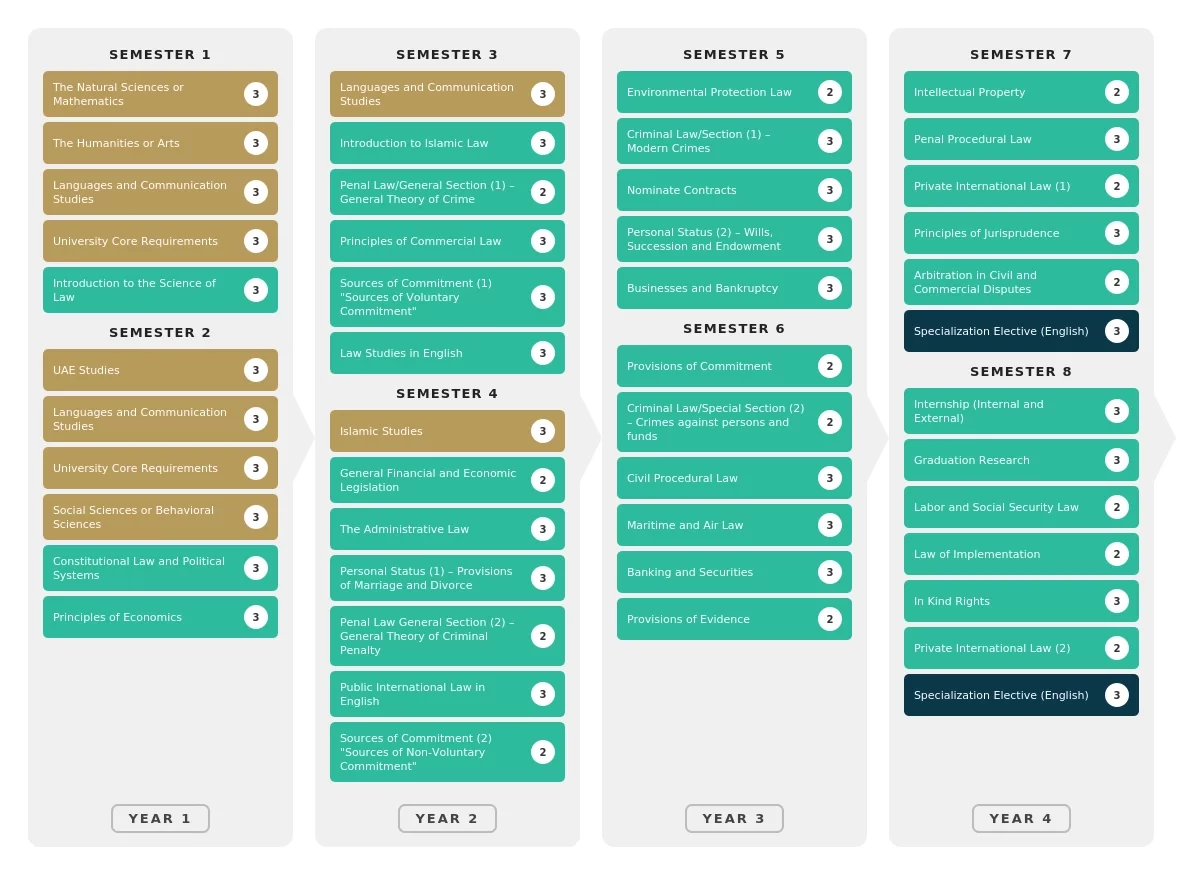
RECOMMENDED STUDY PLAN

ATTENDANCE
Weekday Morning Classes
MON – WED | BETWEEN 9:00 AM – 4:00 PM
Weekday Evening Classes
MON – WED | BETWEEN 4:00 PM – 9:00 PM