

Master of Science in AI and Data Science
Master the Future of Intelligence and Innovation
In an era defined by rapid digital transformation, the ability to harness the power of intelligent machines and vast amounts of data has become one of the most valuable skillsets of the 21st century. The Master of Science in Artificial Intelligence and Data Science (MSAIDS) at AUE is not just a postgraduate degree—it’s a launchpad for visionary thinkers, problem-solvers, and change-makers who are ready to lead the next wave of technological evolution.
Artificial Intelligence and Data Science are at the core of today’s most groundbreaking advancements—from predictive healthcare and autonomous vehicles to smart cities, financial forecasting, and intelligent robotics. Our MSAIDS program is designed to prepare students for the profound impact these technologies are having—and will continue to have—on society, industries, and human potential.
This program offers more than technical mastery. It is a transformative academic journey that combines rigorous scientific foundations, hands-on experience, and ethical foresight. Students will engage with complex datasets, develop intelligent systems, master machine learning and deep learning techniques, and explore the legal, societal, and ethical dimensions of AI in a globalized world.
What Makes Our Program Unique?
At AUE, we don’t just teach AI and Data Science—we cultivate innovators who will define its next frontier. Here’s what sets our program apart:
- Cutting-Edge Curriculum: A strategically designed sequence of courses that covers data engineering, machine learning, deep learning, ethics, research methodologies, and specialized topics in computer vision, NLP, decision systems, and intelligent agents.
- Hands-On Thesis Experience: Our two-stage thesis journey enables students to dive into real-world research and contribute original work to the field under expert supervision.
- Future-Ready Specializations: With electives in cloud-based AI, robotics, digital image processing, and cognitive systems, students gain practical skills aligned with industry’s evolving needs.
- Global Perspective, Local Relevance: We prepare students to address global challenges while responding to UAE and regional demands for AI innovation, ethical governance, and data-driven decision-making.
- Expert Faculty & Research Culture: Learn from faculty actively engaged in groundbreaking research and supported by a thriving academic ecosystem that values innovation and collaboration.
Who Should Join This Program?
This program is ideal for professionals and graduates with a background in computing, engineering, mathematics, or related fields who want to become leaders in AI, machine learning, and data science. Whether you aspire to be a data scientist, AI engineer, or applied researcher, this is your launchpad.
Program Mission
To develop highly skilled AI and data science professionals capable of designing intelligent systems, analyzing complex datasets, and making ethical, data-driven decisions that transform industries, drive innovation, and serve society.
Program Learning Outcomes
Graduates will be able to:
- Identify, analyze, and define complex AI and Data Science problems, applying advanced principles of computing, mathematics, and domain-specific knowledge to develop effective and innovative solutions.
- Design, develop, and evaluate sophisticated AI and Data Science models, algorithms, and systems that address real-world challenges, considering factors such as scalability, performance, and constraints.
- Apply advanced mathematical, statistical, and computational methods to model data, derive insights, and create state-of-the-art machine learning and AI-based solutions.
- Demonstrate an understanding of ethical, legal, and societal implications of AI and Data Science, making informed decisions that promote fairness, transparency, and responsible use of data.
- Develop leadership skills to lead interdisciplinary teams effectively, communicate technical information and data-driven insights clearly, and collaborate efficiently in AI and Data Science projects.
- Continuously acquire and apply new knowledge in AI and Data Science, adapting to evolving technologies, methodologies, and industry standards with an emphasis on research and innovation.
Program Goals
Goal 1. Equip students with specialized knowledge and skills to solve real-world challenges.
Goal 2. Instill ethical practices and promote responsible AI.
Goal 3. Foster lifelong learning and adaptability to evolving technologies.
Goal 4. Develop leadership and interdisciplinary collaboration skills.
Goal 5. Promote innovation and research for impactful solutions.
Career Opportunities
Graduates of the MSAIDS program will be prepared to pursue roles such as:
- Data Scientist
- Machine Learning Engineer
- AI Researcher
- Business Intelligence Specialist
- Deep Learning Architect
- AI Policy and Ethics Advisor
- Cloud AI Developer
- Intelligent Systems Designer
These roles span industries including finance, healthcare, government, manufacturing, cybersecurity, retail, and transportation.
ADMISSION REQUIREMENTS
Admission to the Master of Science in Artificial Intelligence and Data Science (MSAIDS) program is governed by AUE's Graduate Admission Policy and Procedure and is fully compliant with the Commission for Academic Accreditation (CAA). Applicants holding a recognized bachelor's degree in Artificial Intelligence, Computer Science, Computer Engineering, Software Engineering, Information Technology, Computer Information Systems, Data Science, Electrical/Electronic Engineering, or a closely related field, with a cumulative GPA of 3.0 or higher (on a 4.0 scale), are granted regular admission, while applicants who do not meet the criteria for regular admission may be considered for admission on probation based on their academic background and cumulative GPA, subject to clearly defined conditions.
Applicants admitted on probation are required to complete designated courses under the Academic Readiness and Competency Program (ARCP), which is designed to address foundational competency themes in (1) programming, data structures, and algorithms, and (2) artificial intelligence, to ensure adequate preparation for graduate-level study. The number of ARCP courses assigned and whether limited enrollment in master-level coursework is permitted during the probationary semester is determined by the Program Director or Student Advisor with the approval of the Dean, in accordance with the approved GPA bands and field-of-study categories. ARCP courses are assessed on a Pass/Fail basis, do not count toward the master's degree credit hours or cumulative GPA, and must be successfully completed within the probationary period; failure to meet the specified probationary requirements, including minimum performance in any permitted master-level course, results in automatic dismissal from the program. English language proficiency and all other general graduate admission requirements remain applicable in all cases.
ACCREDITATION

PROGRAM STRUCTURE
Course Category
Total Number of Courses
Total Number of Credit Hours
Core Courses
6
18
Elective Courses
2
6
Thesis Course
1
6
Total
9
30 Credit Hours
PROGRAM Courses
Core Courses
18 CREDIT HOURS
Elective Courses
6 CREDIT HOURS
This course offers an in-depth exploration of digital image processing, focusing on the fundamental theories and advanced techniques essential for analyzing, enhancing, and interpreting images. Students will gain expertise in image formation, sampling, and quantization, along with advanced methods for spatial and frequency-domain filtering, noise reduction, and color image processing. The course covers essential topics such as wavelet transformations, image compression, and morphological operations, enabling students to perform effective feature extraction, segmentation, and shape analysis. Practical applications and projects allow students to apply these concepts to real-world image processing challenges, equipping them with the skills to develop innovative solutions for fields like medical imaging, remote sensing, and automated inspection.
This course offers an in-depth exploration of advanced Natural Language Processing (NLP) with a focus on transformer models. Students will learn the architecture, functionality, and applications of transformers in key NLP tasks such as text classification, named entity recognition, summarization, and question answering. The course emphasizes practical skills in fine-tuning and training transformers, understanding attention mechanisms, and leveraging pre-trained models using the Hugging Face library. Additionally, students will work collaboratively to develop projects, explore emerging trends, and tackle challenges such as zero-shot learning and multilingual NLP.
This course provides an in-depth understanding of cloud computing technologies and their applications in AI and Data Science. It covers the architecture, deployment models, and services of cloud platforms, such as AWS, Google Cloud, and Microsoft Azure, that enable scalable data processing, machine learning, and big data analytics. Through a blend of theoretical knowledge and hands-on experience, students will learn how to leverage cloud infrastructures to develop and deploy AI-driven applications and data-intensive systems. Key topics include cloud service models (IaaS, PaaS, SaaS), machine learning in the cloud, cloud storage, data security, and the ethical considerations of using cloud resources for AI. By the end of the course, students will be equipped to design and implement data-driven AI applications in a cloud environment, addressing real-world challenges in scalability, performance, and resource management.
This course provides an in-depth exploration of Business Intelligence (BI), Analytics, and Decision Support Systems (DSS). It covers essential concepts, frameworks, and technologies for strategic and operational decision-making. Students will learn about the architecture and applications of BI systems, data warehousing, descriptive and predictive analytics, and advanced modeling techniques. Emphasis is placed on real-world case studies, hands-on projects, and collaborative exercises. The course also addresses emerging trends such in AI, Big Data, and the Internet of Things (IoT), preparing students to effectively leverage analytics for business success.
This course provides an in-depth exploration of intelligent agents and multi-agent systems, focusing on the principles, design, and application of autonomous agents that interact, communicate, and cooperate in dynamic environments. Students will examine foundational concepts such as agent architecture, reasoning mechanisms, communication protocols, and coordination strategies. Through practical exercises, students will implement various agent-based models, explore game theory and negotiation in multi-agent interactions, and apply agent-based methodologies to real-world scenarios. The course emphasizes collaborative learning, where students work in teams to develop, analyze, and present multi-agent solutions for complex, real-world problems, preparing them for advanced roles in autonomous systems and AI-driven applications.
This course provides an in-depth exploration of AI robotics, covering the essential principles, architectures, and algorithms used in the development of intelligent autonomous systems. Students will study foundational concepts, including levels of autonomy, decision-making, perception, and sensor integration. Emphasis is placed on software architectures, reactive and deliberative behavior systems, and the practical application of algorithms for navigation, path planning, localization, and mapping. Through hands-on projects and collaborative activities, students will develop and implement robotic solutions, gaining experience in team-based design and problem-solving within the context of AI-driven robotics.
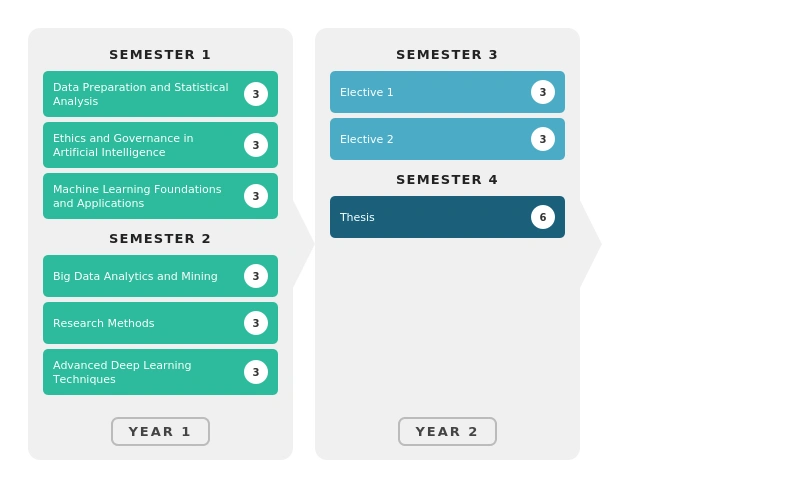
RECOMMENDED STUDY PLAN
Program Director
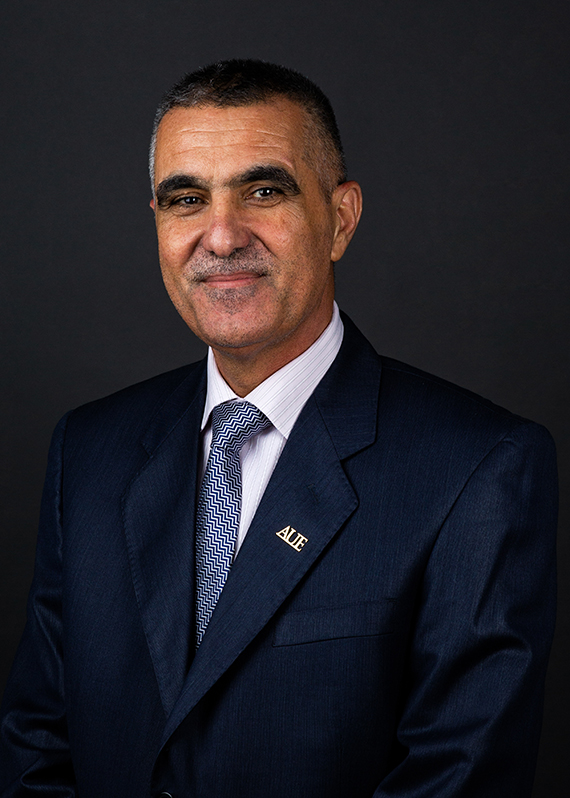
Prof. Faruq Al-Omari
Acting Program Director of the Master of Science in AI and Data Science