
Master of Education

Helpful Links


About Program
Program Goals
Program Learning Outcomes
Career Opportunities
About Program

Overview

The Master of Arts in Education at the American University in the Emirates (AUE) is designed to empower aspiring and practicing educators with the knowledge, skills, and mindset needed to lead and innovate in today’s diverse educational landscapes. This interdisciplinary program balances educational theory with practical application, preparing graduates to become reflective practitioners, effective leaders, and advocates for inclusive, student-centered learning environments.

Through a curriculum grounded in evidence-based practices and global perspectives, students will explore key topics such as curriculum design, educational leadership, assessment and evaluation, educational technology, and inclusive practices. The program supports both local and international educational priorities, equipping graduates with the tools to make a meaningful impact across schools, higher education institutions, and education-related organizations.

What Makes Our Program Unique

  • Flexible Learning for Working Professionals: Courses are offered during evenings and weekends to accommodate educators, school leaders, and professionals with full-time commitments.
  • Focus on Innovation & Leadership: Our curriculum emphasizes creativity, critical thinking, and leadership development to shape future-ready education professionals.
  • Global Perspective in a Local Context: Located in Dubai, a global education hub, the program addresses regional educational challenges while preparing students to work in international settings.
  • Diverse Learning Environment: AUE’s multicultural community enhances learning through cross-cultural exchange and collaborative projects.

Who Should Join This Program

  • Current teachers seeking advanced knowledge and leadership roles in schools.
  • Education professionals looking to transition into curriculum development, policymaking, or administrative positions.
  • Graduates from other fields who aspire to enter the education sector with a strong theoretical and practical foundation.
  • Individuals interested in advancing inclusive and equitable education practices.

Program Goals

1: Instill in students a thorough awareness of and comprehension of International trends in education to help them develop the critical thinking and international system comparison skills necessary for success.

2: Empower students to practice inclusive teaching strategies that honor cultural diversity and guarantee fair educational opportunities for every student.

3: Inspire students to create innovative curricula by including multicultural content, International viewpoints, and a knowledge of various teaching methodologies.

4: Equip students with the tools they need to use data wisely in order to make decisions in the classroom, encouraging ongoing development and evidence-based approaches.

5: Develop leadership abilities that will empower graduates to drive change, encourage teamwork, and overcome obstacles in multicultural learning contexts.

Program Learning Outcomes

1. Acquire a comprehensive knowledge of international education systems to examine different models, highlighting unique characteristics and challenges.

2. Compare various international educational systems to identify key elements of international competence in curriculum design, and to construct curriculum frameworks that are culturally responsive and inclusive, integrating international perspectives and multicultural content.

3. Formulate approaches for incorporating Artificial Intelligence tools and techniques in an educational context to enhance learning experience and to predict future AI development in educational field.

4. Implement teaching strategies that are inclusive and responsive to diverse cultural needs, promoting a culture of continuous learning and improvement within educational settings.

5. Apply advanced research methodologies to effectively identify, critique, and address educational challenges and best practices in the educational landscape.

Career Opportunities

Graduates of the MA in Education program will be well-equipped for roles such as:

  • School Leader or Principal
  • Instructional Coordinator
  • Curriculum Specialist
  • Educational Consultant
  • Policy Advisor in Education Ministries or NGOs
  • Academic Advisor or Student Affairs Officer
  • University Lecturer (with further qualifications)
  • Education Technology Integrator

ADMISSION REQUIREMENTS

  • A recognized undergraduate degree, typically in Education or a related field (e.g., Psychology, Social Sciences, Liberal Arts).
  • Minimum CGPA 3.00 out of 4.00.
  • All applicants who got less than 3.0 CGPA (but not less than 2.5) or its equivalent at their bachelor’s degree will be conditionally admitted to the university for one semester, where they can register no more than 9 CH of remedial courses and should achieve a CGPA of 3.0 in their first semester.
  • A minimum of 6.0 on the IELTS or 79 on the TOEFL iBT or TOEFL ITP 550
  • Applicants must attend an admissions interview with the Program Representative.
  • Applicants are required to write a one-page (500-word) personal admissions statement in English.


Program Structure


Study Plan


Courses


GET IN TOUCH

Fee Structure

Fall 2025-26

Duration

2 Years

Yearly Tuition Fees

AED 39,000/USD 10,619
*VAT 5% inclusive
Excluding Service fees
Note: Yearly fees will vary depending on number of courses enrolled

Scholarships

Scholarships upto 50%
For More Details Contact
Office of Student Life & Community Engagement

PROGRAM STRUCTURE

Course Category

Total Number of Courses

Total Number of Credit Hours

Core Courses

6

18

Elective Courses

2

6

Thesis 1

1

3

Thesis 2

1

3

Total

30 Credit Hours

PROGRAM courses

Core Courses
Elective Courses
Thesis
Core Courses

CORE COURSES

6 COURSES | 18 CREDIT HOURS

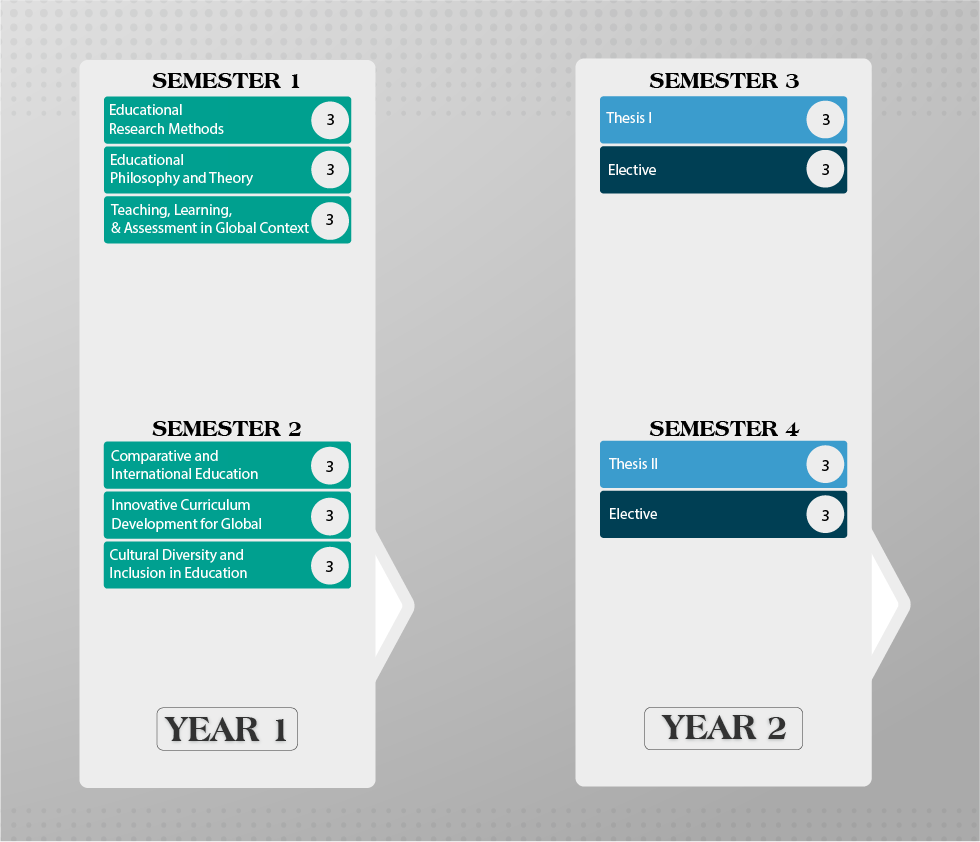
1. Educational Research Methods – (3)
This course is designed to provide an in-depth understanding of research methodologies in education and equip master students with the skills needed to engage in research for dissertation. It covers qualitative, quantitative, and mixed-method approaches. Students will learn how to design research studies, analyze data, and critically evaluate research in educational contexts. The course prepares students to develop their own research proposals, emphasizing ethical considerations and practical applications.
2. Educational Philosophy and Theory – (3)
This course explores key theories and philosophies that have shaped education throughout history and continue to influence educational practices today. Through the course, students will engage with classical and contemporary philosophical ideas and examine their impact on curriculum design, teaching methods, and educational policy. The course aims to deepen students’ understanding of the philosophical foundations of education and develop their ability to critically analyze and apply these ideas in their own educational contexts.
3. Teaching, Learning, & Assessment in Global Context – (3)
This course is designed to explore a variety of teaching methodologies and their application in diverse and international educational environments and discover the principles and practices of assessment and evaluation in various K-12 educational contexts. It focuses on adapting and implementing teaching methods to meet the unique needs of learners from various backgrounds. The course places a significant emphasis on developing innovative and inclusive instructional practices that are effective in global K-12 classrooms. It also emphasizes the importance of creating fair and differentiated assessment techniques taking into consideration diverse educational settings and learners’ backgrounds and needs. Key areas of focus include the integration of technology in teaching to enhance learning experiences, the development of cross-cultural communication skills, both of which are crucial in today’s interconnected world, and effective strategies and practices in evaluating K-12 students’ attainment and performance and their impacts on educational policies and decision-making.
4. Comparative and International Education – (3)
This course provides an in-depth exploration of the principles and practices of assessment and evaluation in various educational contexts around the world. It emphasizes the importance of creating fair and effective assessment techniques that are adaptable to diverse educational settings and sensitive to different cultural backgrounds. Throughout the course, students will delve into a variety of assessment models, understanding their role in driving educational improvement and learning outcomes. A key focus of the course is on strategies to ensure equity in assessment practices, ensuring that all learners, regardless of their background, are assessed in a manner that is both fair and comprehensive. This includes an exploration of best practices in evaluating student learning and performance, as well as understanding the impact of these practices on educational policies and decisions.
5. Innovative Curriculum Development for Global Competence – (3)
This course focuses on equipping educators with the skills and knowledge necessary to design curricula that foster global competence. Students will explore the principles of curriculum development with an emphasis on intercultural understanding, global awareness, and the capacity to engage with people from diverse backgrounds. The course includes strategies for integrating international perspectives and standards into curriculum planning and evaluation. Emphasis will be placed on creating learning experiences that prepare students for a globalized world, encouraging critical thinking, cross-cultural communication skills, and global citizenship.
6. Cultural Diversity and Inclusion in Education – (3)
The course dedicated to the exploration and implementation of strategies to create and maintain inclusive educational environments that value and celebrate cultural diversity. The course delves into the concepts of multicultural education, equity, and inclusion, providing educators with a comprehensive understanding of these crucial areas. The course is designed to equip educators with the practical tools and theoretical knowledge necessary to foster an inclusive classroom atmosphere. This inclusive atmosphere is not only conducive to learning but also promotes respect and appreciation for cultural diversity among students. The ultimate goal of this course is to prepare educators to effectively address and embrace the challenges and opportunities presented by cultural diversity in educational settings.

Elective Courses

Elective Courses

CHOOSE 2 COURSES | 6 CREDIT HOURS

1. International Education Policy – (3)

This course offers an extensive exploration of international education policies and how they are created and put into action globally. Students will explore how international organizations along with governments and non-governmental organizations play a part in shaping policies. The focus of the class is on comparing and analyzing educational policies, discussing the challenges faced in transferring policies from one context to another and understanding how global trends in education impact national education systems.

2. Leadership and Change Management in a Global Context – (3)

This course navigates into leadership theories and change management strategies within the context of global education. It aims to develop leadership skills that are effective in diverse cultural settings. The course thoroughly examines strategies for leading and managing change in educational institutions, addressing global leadership challenges, effective communication across cultures, and practical techniques for implementing change. This course is pivotal for educational leaders aiming to navigate and influence the evolving global educational landscape effectively.

3. Learning Organizations & Leadership Role – (3)

The course explores transforming educational institutions into dynamic entities. It expands upon the idea of how these organizations can evolve to be more responsive, creative, and perpetually enhance their teaching and administrative environments. The course rigorously examines various models and frameworks that define a learning organization, emphasizing the role of leadership in cultivating a culture that embraces change and innovation. It also explores how organizational culture and leadership practices can significantly influence learning outcomes and the effectiveness of educational practices. Furthermore, it provides practical insights into planning and implementing strategies that encourage ongoing development and growth within educational environments, making it an essential component for educators and administrators aiming to lead in the evolving landscape of global education.

4. Artificial Intelligence Applications in Educational Contexts – (3)

The course explores the Artificial Intelligence (AI) fundamentals and its diverse applications in enhancing teaching, learning, and educational management. The course offers understanding of the theoretical foundation of AI in education, current applications of AI in education, advanced teaching, learning, and assessment AI tools, and the management of educational systems. Students will critically analyze ethical considerations, navigate the challenges of AI integration in education, and predict AI’s future potential and impact on the educational landscape.

5. Practicum – (3)
The Practicum course is designed to cater to students who lack prior teaching experience. While the program primarily targets current teachers and school administrators, it acknowledges the importance of accommodating individuals aspiring to enter the educational field. As a result, the course is offered as an elective option for these individuals.
This course provides a unique and practical hands-on experience, offering participants a valuable opportunity to acquire real-world teaching and administrative skills within an educational setting. Tailored for those new to the field, the Practicum serves as an ideal platform for building competencies and boosting confidence in a supportive and structured environment. By engaging in this course, students ensure they are well-prepared for a successful and fulfilling career in education.

Thesis

THESIS

6 CREDIT HOURS

1. Thesis 1 – (3)
Students in this course will work with their thesis supervisor to develop a thesis proposal and begin their distinctive, applied research project. The primary goal is for the student to practice the mechanisms of transitioning from concept to active inquiry. Depending on the nature of the topic, the student will develop a study questions, conduct a literature review, develop a methodological approach, and begin preliminary research. Students are expected to apply qualitative, quantitative, and comparative research approaches to the chosen topic. Students will be required to provide the oral defense of Thesis Proposal as part of the assessment and fulfillment of the Thesis 1 course.
2. Thesis 2 – (3)
In this course, students will continue developing their thesis project, revising techniques (if required), addressing challenges, analyzing findings, and eventually articulating the complete experience. Students will build on work from the previous semester and put all of the pieces together to complete the final thesis project, following the required research process and procedures. The thesis is a work of original scholarship, designed with guidance from a thesis supervisor and thesis committee. Students will be required to provide the oral public defense as part of the assessment and fulfillment of the Thesis course.

RECOMMENDED STUDY PLAN


Program Director

Dr. Michael McIntosh

Associate Professor / Program Director of the Master of Education

JOINING THE PROGRAM

Student can join at the beginning of any semester

SEPTEMBER

FALL SEMESTER

JANUARY

SPRING SEMESTER

MAY

SUMMER SEMESTER